projects/
seagull/
Seagull Dual Path O.D. Drive Tape Burnisher

This machine both burnishes and wipes the surface of hard drive disks.
I built all the automation for the prototype, wired the electronics and
wrote software for the controls.
Demonstration Video of the Prototype Unit:

LabView Interface Program:
Prototype Wiring:
Details:
Seagull designed the dual path O.D. drive
tape burnisher for manufacturers in the hard drive industry. This machine
both burnishes and wipes the surface of hard drive disks. Disk manufacturers
burnish the disks in various stages of the manufacturing process. Some
manufacturers, for example, burnish their disks directly after dipping them
in lube, because the burnishing heats up the surface of the disk (which
bonds the lube to the disk surface), then after burnishing they wipe the
disks to remove the excess lube. The Seagull dual path tape burnisher is
only a fraction of the size of burnisher machines used in manufacturing
lines now. It spins the disks using the outer diameter of the disks (O.D.)
unlike other machines that use the inner diameter (I.D.). Using the O.D.
allows this machine to burnish the entire surface of the disk. Machines that
grip the disk by the I.D. cannot burnish the disk surface close to the I.D.
of the disk.
My part of this project was to completely automate the tape burnisher and
turn it into a standalone unit for demonstrations and trade shows. My goal
was to build one prototype standalone unit, then later reconfigure the tape
burnisher controls so that it could easily integrate into any manufacturer's
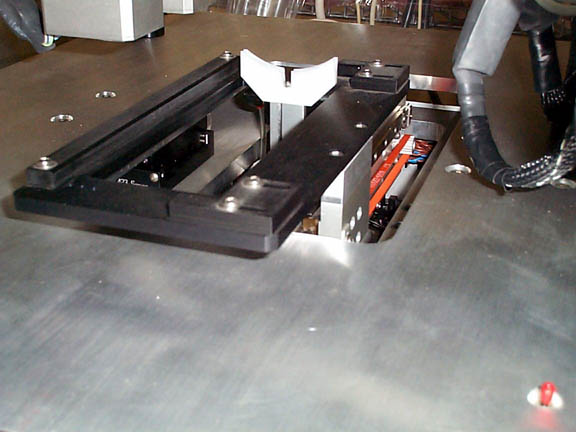
production line. I built a disk lifter to raise disks one-by-one from a disk
cassette into the tape burnisher unit. I wired the motors, sensors, airpots,
and pneumatic actuators on both the lifter and the burnisher to a PLC. Then
I programmed the PLC to automatically cycle through one cassette of disks,
lifting a single disk at a time out of the cassette and into tape burnisher
where it would get burnished for some set amount of time then get placed
back into the cassette. The disk lifter then advanced the cassette to the
next disk using a stepper motor and continued the cycles until the entire
cassette of disks had been processed. I wrote an interface program in
LabView to allow an operator to quickly reprogram process variables, such as
burnish time, disk rotation speed, and tape speed, using the serial port of
any computer running Windows.